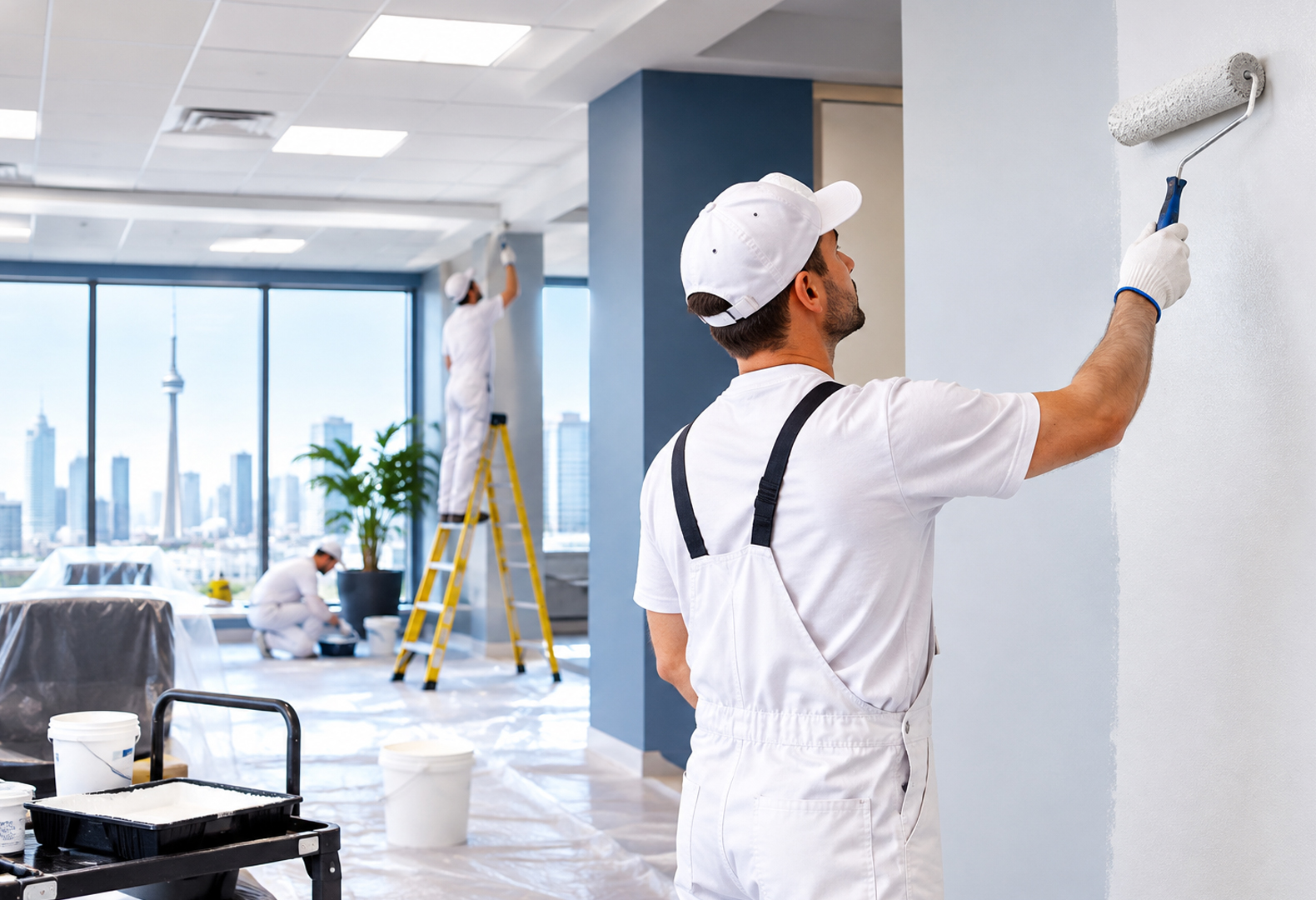
Painting a commercial property is mostly a scheduling problem. The actual painting is the easy part. The hard part is doing it while a clinic still sees patients, a restaurant still serves dinner, or two hundred condo residents still need to get from the elevator to their front doors.
This guide is for property managers, condo boards and business owners planning commercial painting in Toronto. It covers how to write a scope that gets you comparable quotes, which coatings hold up in which areas, the Toronto rules that shape your schedule, the paperwork to collect before day one and how a phased job actually runs.
Write the Scope Before You Ask for Quotes
If three contractors walk your building with no written scope, you’ll get three quotes for three different jobs. One includes ceilings, one doesn’t. One allows for two coats, another for one. Comparing them becomes guesswork.
A short scope document fixes that. It doesn’t need to be formal. It should cover:
- Every area included, by floor or zone (lobby, corridors, stairwells, units, washrooms, back of house)
- Surfaces in each area: walls, ceilings, doors, frames, railings, trim
- Known repairs, such as drywall damage, water stains or rust on metal
- Required hours of work and any areas that must stay open
- Building rules: sign-in, elevator booking, loading dock windows, parking
- Colour and sheen per area, or a request for colour guidance
Then ask every contractor to quote against it. Brightlook quotes commercial work against a written scope, and off-hours scheduling appears as its own line on the quote, so there’s no surprise invoice for evening work later.
Match the Coating to the Traffic
This is where commercial jobs differ most from residential ones. A paint that’s fine in a bedroom can fail within months in a busy corridor, where carts, luggage and cleaning crews hit the walls every day. Standard residential paint is usually the first thing to fail in those spaces.
Area | What it faces | Coating approach |
Lobbies and reception | Constant foot traffic, frequent cleaning, first impressions | Scrubbable acrylic that handles regular washing |
Corridors and elevator lobbies | Carts, luggage, moving days, scuffs at hip height | Durable scrubbable finish; tougher coatings where damage is constant |
Stairwells | Hand contact, railings, dust | Cleanable wall finish; metal railings prepped and coated for wear |
Clinics and offices | Daily cleaning, low tolerance for odour during hours | Washable finish, scheduled outside patient or staff hours |
Restaurants | Grease, heat, steam and heavy cleaning | Hard-wearing, cleanable finish in back-of-house areas |
Warehouses | Equipment, forklifts, safety markings | Epoxy or urethane-modified finishes where traffic calls for it; line marking and safety colours to spec |
Ask your painter what product they’re specifying for each area and why. A clear answer tells you they’ve thought about how the space is used as well as how it looks.
Toronto Rules That Shape Your Schedule
After-hours painting solves the disruption problem, but it brings its own constraints in Toronto.
The first is noise. Toronto’s noise by-law,
Municipal Code Chapter 591, restricts clearly audible construction noise and the operation of construction equipment, which includes power tools and air compressors, from 7 p.m. to 7 a.m. on weekdays, until 9 a.m. on Saturdays, and all day on Sundays and statutory holidays. Quiet brush-and-roll work inside a closed space is rarely the issue. Sanding, compressors for spray equipment and other powered prep can be. So a good overnight plan puts the noisy prep inside permitted hours and saves the quieter painting for after closing. If your project needs loud work outside those hours, check the by-law and whether an exemption applies before you book.
The second is your own building’s rules. Most Toronto towers and plazas have sign-in procedures, elevator bookings and loading dock windows, and condo corporations often add notice requirements for residents. Brightlook works within those rules, from sign-in sheets to elevator bookings and dock times, and phases condo and multi-unit work so residents keep access to their units throughout.
Collect the Paperwork Before Day One
Property managers and general contractors will usually ask for two things before any crew starts: proof of insurance and proof of WSIB coverage.
A WSIB clearance is a number the WSIB issues to show a business, contractor or subcontractor is registered and up to date. Each clearance lasts up to 90 days, so ask for one that’s current for your project dates. Brightlook carries commercial general liability insurance and maintains WSIB clearance, and sends certificates to property managers and general contractors on request, typically before the start date.
How a Phased Commercial Job Runs
Phasing is what lets a building stay open while it’s painted. The space is split into zones, and each zone has its own start time and handback time.
At Brightlook, a commercial project starts with a site walk and a written quote. Then we build the schedule around your hours and access needs, mapping which areas can go offline first and which have to stay open. Each zone is protected, painted and cleaned before it’s handed back, and there’s a final check with you before we wrap up. The written schedule says when each area reopens, and that’s when it reopens.
How long does it take? A small office or retail unit often wraps up in a few days. Larger, multi-zone buildings can run several weeks, phased around how the property operates. Square footage, the number of zones and the hours available per shift all affect the timeline.
One practical tip for condos: share the zone schedule with residents a week ahead, and post it in the elevators. Residents are far more patient when they know what’s coming.
Getting Your Toronto Property Quoted
Put your scope on paper, list your building rules and decide which areas must stay open. Then ask for a written schedule along with the quote.
Brightlook handles commercial painting across Toronto and the GTA for offices, retail units, restaurants, clinics, warehouses and condo buildings. Evening, overnight and weekend scheduling is standard on our commercial projects, and we use Sherwin-Williams and Benjamin Moore by default. Submit your project through the form and you’ll get a written scope and quote within one business day. See the details on our
commercial painting page or
request your free estimate.
Frequently Asked Questions